
Bacterias Anammox y su Aplicación Biotecnológica en Lixiviados de Residuos Orgánicos
 Descargas: 43
DOI:
https://doi.org/10.56845/terys.v5i2.759Palabras clave:
bacterias anammox, residuos sólidos orgánicos, tratamiento de lixiviados, biotecnología ambiental, sostenibilidadResumen
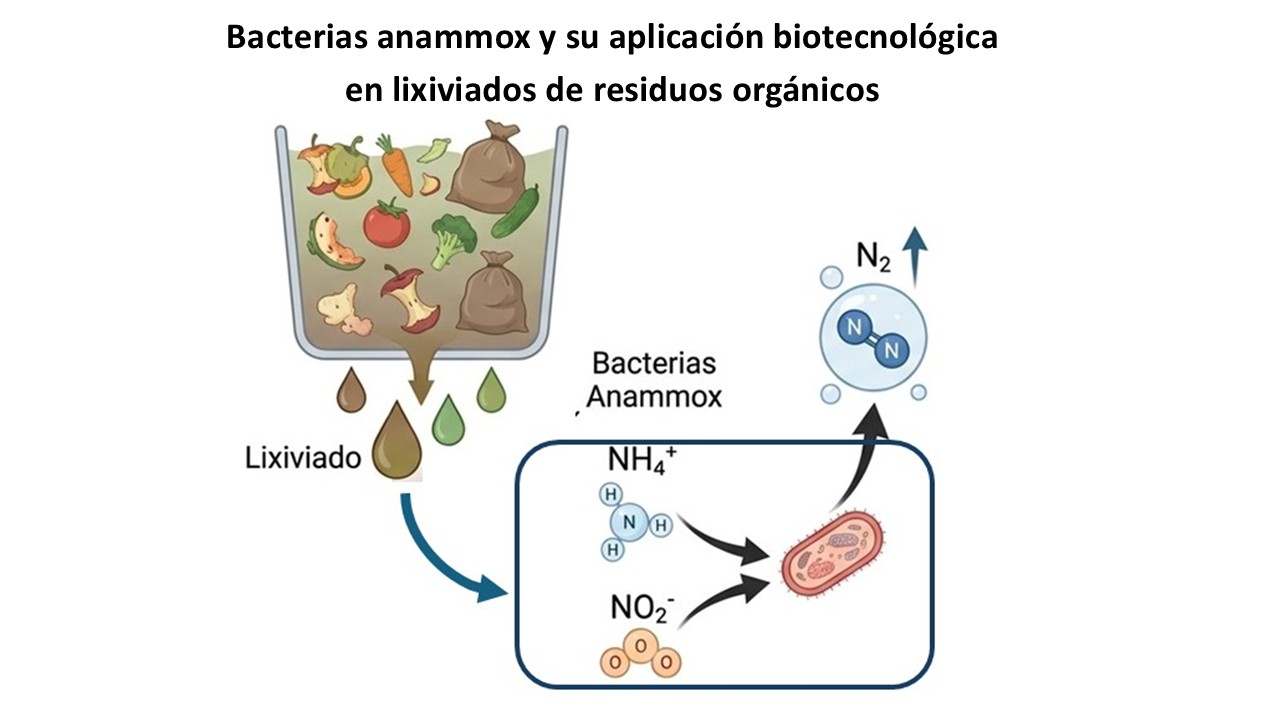
Las bacterias anammox son microorganismos de gran interés biotecnológico que en los últimos años han permitido mejorar la comprensión de la dinámica del nitrógeno en el medio ambiente. Estas bacterias tienen la capacidad de transformar el amonio y el nitrito en nitrógeno molecular bajo condiciones anaerobias, lo que puede reducir los requerimientos de oxígeno del tratamiento en comparación con los métodos tradicionales de eliminación de nitrógeno. El presente trabajo explora la aplicación del proceso anammox en el tratamiento de lixiviados de residuos orgánicos. En ensayos realizados en reactores de laboratorio bajo condiciones controladas y utilizando lixiviado diluido, se alcanzaron remociones de nitrógeno amoniacal cercanas o superiores al 90 %, dependiendo de la concentración inicial y del tiempo de tratamiento. Por ejemplo, una concentración inicial de 200 mg N-NH₄⁺/L disminuyó hasta aproximadamente 20 mg N-NH₄⁺/L después de cuatro días de tratamiento. Estos resultados corresponden a condiciones experimentales y representan una evaluación de la viabilidad del proceso.
Citas
Adams, M., Xie, J., Kabore, A. J., Chang, Y., Xie, J., Guo, M., & Chen, C. (2022). Research advances in anammox granular sludge: A review. Critical Reviews in Environmental Science and Technology, 52(5), 631–674. https://doi.org/10.1080/10643389.2020.1831358 DOI: https://doi.org/10.1080/10643389.2020.1831358
Ahmad, H., Ahmad, S., Gao, L., Wang, Z., El-Baz, A., & Ni, S. (2023). Energy-efficient and carbon neutral anammox-based nitrogen removal by coupling with nitrate reduction pathways: A review. Science of the Total Environment, 889, 164213. https://doi.org/10.1016/j.scitotenv.2023.164213 DOI: https://doi.org/10.1016/j.scitotenv.2023.164213
Ali, M., & Okabe, S. (2015). Anammox-based technologies for nitrogen removal: Advances in process start-up and remaining issues. Chemosphere, 141, 144–153. https://doi.org/10.1016/j.chemosphere.2015.06.094 DOI: https://doi.org/10.1016/j.chemosphere.2015.06.094
Cao, Y., van Loosdrecht, M., & Daigger, G. (2017). Mainstream partial nitritation–anammox in municipal wastewater treatment: Status, bottlenecks, and further studies. Applied Microbiology and Biotechnology, 101, 1365–1383. https://doi.org/10.1007/s00253-016-8058-7 DOI: https://doi.org/10.1007/s00253-016-8058-7
Chen, Y., Zheng, R., Sui, Q., Ritigalaa, T., Wei, Y., Cheng, X., Ren, J., Yu, D., Chen, M., & Wang, T. (2021). Coupling anammox with denitrification in a full-scale combined biological nitrogen removal process for swine wastewater treatment. Bioresource Technology, 329, 124906. https://doi.org/10.1016/j.biortech.2021.124906 DOI: https://doi.org/10.1016/j.biortech.2021.124906
Feng, Y., Kong, L., Zheng, R., Wu, X., Zhou, J., Xu, X., & Liu, S. (2024). Adjusted bacterial cooperation in anammox community to adapt to high ammonium in wastewater treatment plant. Water Research X, 100258. https://doi.org/10.1016/j.wroa.2024.100258 DOI: https://doi.org/10.1016/j.wroa.2024.100258
Fux, C., & Siegrist, H. (2004). Nitrogen removal from sludge digester liquids by nitrification/denitrification or partial nitritation/anammox: Environmental and economical considerations. Water Science and Technology, 50(10), 19–26. https://doi.org/10.2166/wst.2004.0599 DOI: https://doi.org/10.2166/wst.2004.0599
Guo, Y., Luo, Z., Shen, J., & Li, Y. (2022). The main anammox-based processes, the involved microbes and the novel process concept from the application perspective. Frontiers of Environmental Science and Engineering, 16, 84. https://doi.org/10.1007/s11783-021-1487-1 DOI: https://doi.org/10.1007/s11783-021-1487-1
Hu, K., Li, W., Wang, Y., Wang, B., Mu, H., Ren, S., Zeng, K., Zhu, H., Liang, J., Wang, Y., & Xiao, J. (2023). Novel biological nitrogen removal process for the treatment of wastewater with low carbon to nitrogen ratio: A review. Journal of Water Process Engineering, 53, 103673. https://doi.org/10.1016/j.jwpe.2023.103673 DOI: https://doi.org/10.1016/j.jwpe.2023.103673
Jetten, M. S. M., van Niftrik, L., Strous, M., Kartal, B., Keltjens, J. T., & Op den Camp, H. J. M. (2009). Biochemistry and molecular biology of anammox bacteria. Critical Reviews in Biochemistry and Molecular Biology, 44, 65–84. https://doi.org/10.1080/10409230902722783 DOI: https://doi.org/10.1080/10409230902722783
Kuenen, J. G. (2008). Anammox bacteria: From discovery to application. Nature Reviews Microbiology, 6(4), 320–326. https://doi.org/10.1038/nrmicro1857 DOI: https://doi.org/10.1038/nrmicro1857
Lackner, S., Gilbert, E. M., Vlaeminck, S. E., Joss, A., Horn, H., & van Loosdrecht, M. C. M. (2014). Full-scale partial nitritation/anammox experiences, an application survey. Water Research, 55, 292–303. https://doi.org/10.1016/j.watres.2014.02.032 DOI: https://doi.org/10.1016/j.watres.2014.02.032
Moreno-Quirós, R. C., Guzmán-López, O., Leal-Ascencio, M. T., Ortiz-Ceballos, Á. I., Castro-Luna, A. A., & Martínez-Hernández, S. (2025a). Characterization of organic waste from the municipal composting center of Xalapa, Veracruz, Mexico. Ecosistemas y Recursos Agropecuarios, 12(3), e4340. https://doi.org/10.19136/era.a12n3.4340 DOI: https://doi.org/10.19136/era.a12n3.4340
Moreno-Quirós, R. C., Ortíz-Ceballos, Á. I., & Martínez-Hernández, S. (2025b). Treatment of municipal organic waste leachates by nitrification: Analysis of the diversity and abundance of canonical and comammox microorganisms. Environments, 12, 479. https://doi.org/10.3390/environments12120479 DOI: https://doi.org/10.3390/environments12120479
Wu, L., Jia, C., Huang, S., Yu, K., Luo, A., & Peng, Y. (2022). Nitrite oxidation in oxygen-deficient conditions during landfill leachate treatment. Environmental Research, 214, 114090. https://doi.org/10.1016/j.envres.2022.114090 DOI: https://doi.org/10.1016/j.envres.2022.114090
Wu, Y., Weng, T., Yeh, T., Chou, P., & Whang, L. (2024). Nitrogen removal strategy for real swine wastewater by combining partial nitrification-denitrification process with anammox. Chemosphere, 364, 143116. https://doi.org/10.1016/j.chemosphere.2024.143116 DOI: https://doi.org/10.1016/j.chemosphere.2024.143116
You, Q. G., Wang, J. H., Qi, G. X., Zhou, Y. M., Guo, Z. W., Shen, Y., & Gao, X. (2020). Anammox and partial denitrification coupling: A review. RSC Advances, 10(21), 12554–12572. https://doi.org/10.1039/D0RA00001A DOI: https://doi.org/10.1039/D0RA00001A
Descargas
Archivos adicionales
Publicado
Cómo citar
Número
Sección
Licencia
Derechos de autor 2026 Roberto Carlos Moreno-Quirós, Oswaldo Guzmán-López, Sergio Martínez-Hernández

Esta obra está bajo una licencia internacional Creative Commons Atribución 4.0.
Los autores conservan los derechos de autor de sus trabajos y conceden a la revista Tendencias en Energías Renovables y Sustentabilidad (TERYS) el derecho de primera publicación.
Los artículos se publican bajo la licencia Creative Commons Atribución 4.0 Internacional (CC BY 4.0), que permite compartir y adaptar el material para cualquier propósito, incluso comercial, siempre que se otorgue el crédito adecuado a los autores y a la revista.
Los autores pueden depositar la versión publicada del artículo en repositorios institucionales o páginas personales, siempre citando la publicación original en TERYS.
 Derechos de autor © D.R. Asociación Latinoamericana de Desarrollo Sustentable y Energías Renovables A. C.,