
Detección de Glucosa a Través del Aliento: Una Alternativa no Invasiva, Renovable y Sustentable
 Descargas: 87
DOI:
https://doi.org/10.56845/terys.v5i2.698Palabras clave:
glucosa, sensor, óxido metálicoResumen
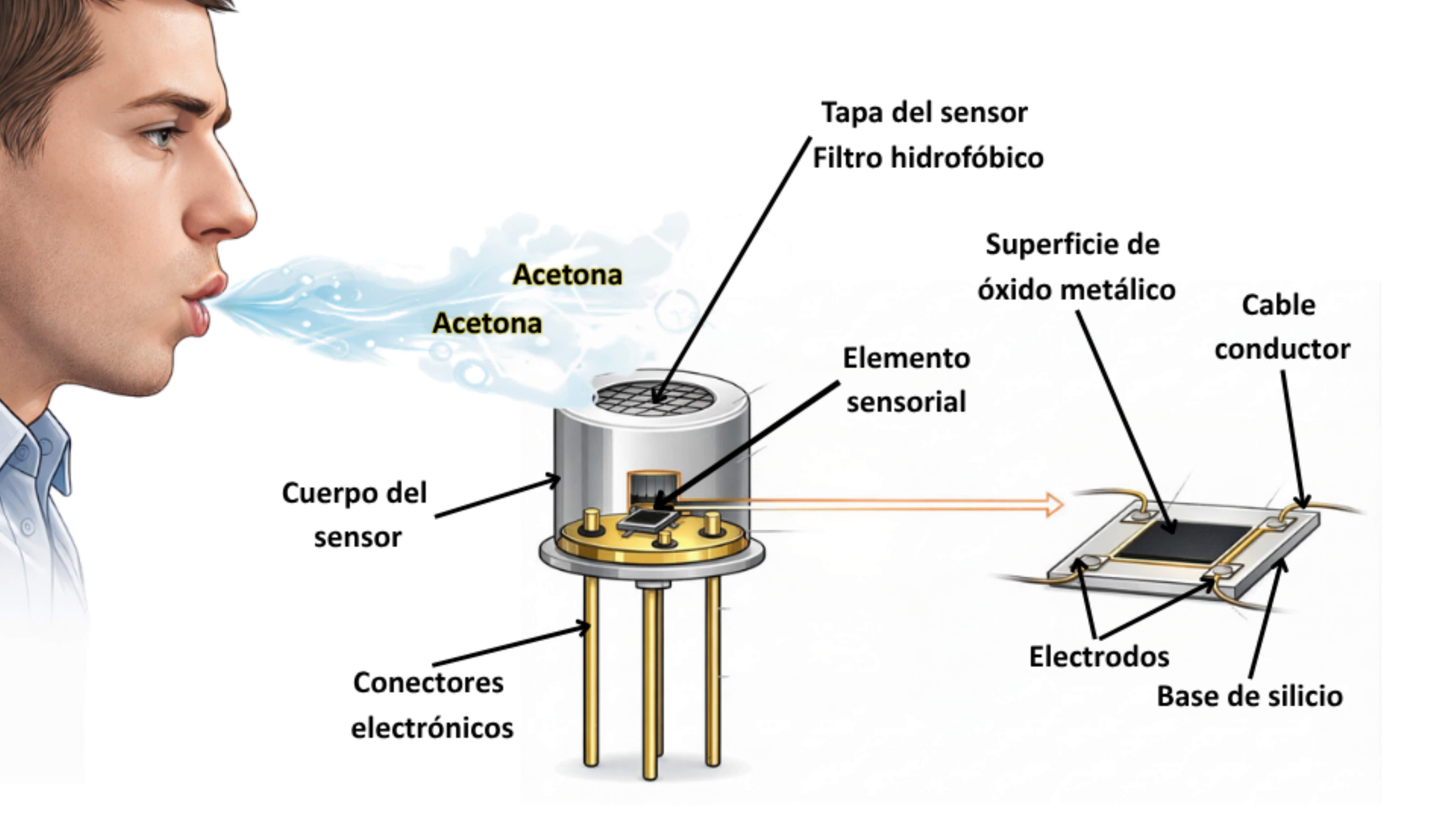
La diabetes constituye uno de los principales desafíos de salud pública a nivel mundial debido a su creciente prevalencia, las complicaciones asociadas y los elevados costos para los sistemas de salud. El monitoreo continuo de la glucosa es fundamental para el control de la enfermedad; sin embargo, los métodos convencionales se basan principalmente en técnicas invasivas que requieren consumibles desechables y generan residuos biomédicos de forma constante. Por ello, las tecnologías de diagnóstico no invasivo han surgido como alternativas con potencial para mejorar la calidad de vida de los pacientes y contribuir al desarrollo de sistemas de atención más sostenibles. Entre las diferentes alternativas para el monitoreo no invasivo de enfermedades, el análisis del aliento humano ha despertado un gran interés debido a la presencia de compuestos orgánicos volátiles (COV) que pueden actuar como biomarcadores metabólicos. Dentro de estos compuestos, la acetona destaca por su relación con el metabolismo de la glucosa, lo que la convierte en uno de los biomarcadores más relevantes para el seguimiento de la diabetes. En este contexto, los sensores de gases basados en óxidos metálicos nanoestructurados, especialmente aquellos desarrollados a partir de SnO2, han mostrado avances importantes en sensibilidad, estabilidad, portabilidad y costo. De esta manera, la incorporación de nanotecnologías y películas delgadas ha impulsado la fabricación de dispositivos más compactos, con menor consumo energético y facilitando el diseño de dispositivos portátiles para aplicaciones de salud. En esta revisión se presentan los avances recientes en sensores para la detección de acetona en el aliento y se analiza su contribución al desarrollo de tecnologías más sustentables, al disminuir la generación de residuos biomédicos, optimizar el consumo de energía y favorecer el acceso al monitoreo de la diabetes en comunidades con recursos limitados.
Citas
American Diabetes Association. (2007). Nutrition recommendations and interventions for diabetes: A position statement of the American Diabetes Association. Diabetes Care, 30(Suppl. 1), S48–S65. https://doi.org/10.2337/dc07-S048
Bajtarevic, A., Ager, C., Pienz, M., Klieber, M., Schwarz, K., Ligor, M., Ligor, T., Filipiak, W., Denz, H., Fiegl, M., Hilbe, W., Weiss, W., Lukas, P., Jamnig, H., Hackl, M., Haidenberger, A., Buszewski, B., Miekisch, W., Schubert, J., & Amann, A. (2009). Noninvasive detection of lung cancer by analysis of exhaled breath. BMC Cancer, 9, 348. https://doi.org/10.1186/1471-2407-9-348
Bandodkar, A. J., & Wang, J. (2014). Non-invasive wearable electrochemical sensors: A review. Trends in Biotechnology, 32(7), 363–371. https://doi.org/10.1016/j.tibtech.2014.04.005
Basto Abreu, A., Reyes García, A., & Barrientos-Gutiérrez, T. (2025). ¿Cómo está la diabetes en México? Instituto Nacional de Salud Pública.
Bi, W., Wang, W., & Liu, S. (2020). Synthesis of Rh–SnO₂ nanosheets and ultra-high triethylamine sensing performance. Journal of Alloys and Compounds, 817, 152730. https://doi.org/10.1016/j.jallcom.2019.152730
Bruen, D., Delaney, C., Florea, L., & Diamond, D. (2017). Glucose sensing for diabetes monitoring: Recent developments. Sensors, 17(8), 1866. https://doi.org/10.3390/s17081866
Buszewski, B., Ulanowska, A., Ligor, T., Denderz, N., & Amann, A. (2009). Analysis of exhaled breath from smokers, passive smokers and non-smokers by solid-phase microextraction gas chromatography/mass spectrometry. Biomedical Chromatography, 23, 551–556. https://doi.org/10.1002/bmc.1141
Chakraborty, S., & Pal, M. (2019). Highly selective and stable acetone sensor based on chemically prepared bismuth ferrite nanoparticles. Journal of Alloys and Compounds, 787, 1204–1211. https://doi.org/10.1016/j.jallcom.2019.02.153
Chen, H., Cai, R., Patel, J., Dong, F., Chen, H., & Minteer, S. D. (2019). Upgraded bioelectrocatalytic N₂ fixation: From N₂ to chiral amine intermediates. Journal of the American Chemical Society, 141(12), 4963–4971. https://doi.org/10.1021/jacs.9b00147
Chen, H., Wortmann, A., Zhang, W., & Zenobi, R. (2007). Rapid in vivo fingerprinting of nonvolatile compounds in breath by extractive electrospray ionization quadrupole time-of-flight mass spectrometry. Angewandte Chemie International Edition, 46, 580–583. https://doi.org/10.1002/anie.200602942
Chung, F.-C., Wu, R.-J., & Cheng, F.-C. (2014). Fabrication of a Au@SnO₂ core–shell structure for gaseous formaldehyde sensing at room temperature. Sensors and Actuators B: Chemical, 190, 1–7. https://doi.org/10.1016/j.snb.2013.08.037
Das, S., & Jayaraman, V. (2014). SnO₂: A comprehensive review on structures and gas sensors. Progress in Materials Science, 66, 112–255. https://doi.org/10.1016/j.pmatsci.2014.06.003
Das, S., Mahapatra, P. L., Mondal, P. P., Das, T., Pal, M., & Saha, D. (2021). A highly sensitive cobalt chromite thick film based trace acetone sensor with fast response and recovery times for the detection of diabetes from exhaled breath. Materials Chemistry and Physics, 262, 124291. https://doi.org/10.1016/j.matchemphys.2021.124291
Di Francesco, F., Fuoco, R., Trivella, M. G., & Ceccarini, A. (2005). Breath analysis: Trends in techniques and clinical applications. Microchemical Journal, 79(1–2), 405–410. https://doi.org/10.1016/j.microc.2004.10.008
Franco, J. H., Klunder, K. J., Russell, V., de Andrade, A. R., & Minteer, S. D. (2020). Hybrid enzymatic and organic catalyst cascade for enhanced complete oxidation of ethanol in an electrochemical micro-reactor device. Electrochimica Acta, 331, 135254. https://doi.org/10.1016/j.electacta.2019.135254
Gaffney, E. M., Lim, K., & Minteer, S. D. (2020). Breath biosensing: Using electrochemical enzymatic sensors for detection of biomarkers in human breath. Current Opinion in Electrochemistry, 23, 26–30. https://doi.org/10.1016/j.coelec.2020.02.014
Georgeous, J., Albasha, L., & Husseini, G. A. (2025). A review of acetone vapor sensors for non-invasive diabetes diagnosis and management: Technologies, challenges and future directions. IEEE Access, 13, 121261–121283. https://doi.org/10.1109/ACCESS.2025.3584863
Grattieri, M., & Minteer, S. D. (2018). Self-powered biosensors. ACS Sensors, 3, 44–53. https://doi.org/10.1021/acssensors.7b00818
Gudiño-Ochoa, A., García-Rodríguez, J. A., Ochoa-Ornelas, R., Cuevas-Chávez, J. L., & Sánchez-Arias, D. A. (2024). Noninvasive diabetes detection through human breath using TinyML-powered e-nose. Sensors, 24(4), 1294. https://doi.org/10.3390/s24041294
International Diabetes Federation. (2025). México: Diabetes data. IDF Diabetes Atlas.
Jadhav, M. R., Wankhede, P. R., Srivastava, S., Bhargaw, H. N., & Singh, S. (2024). Breath-based biosensors and system development for noninvasive detection of diabetes: A review. Diabetes & Metabolic Syndrome: Clinical Research & Reviews, 18(1), 102931. https://doi.org/10.1016/j.dsx.2023.102931
Kao, K.-W., Hsu, M.-C., Chang, Y.-H., Gwo, S., & Yeh, J. A. (2012). A sub-ppm acetone gas sensor for diabetes detection using 10 nm thick ultrathin InN FETs. Sensors, 12(6), 7157–7168. https://doi.org/10.3390/s120607157
Karl, T., Prazeller, P., Mayr, D., Jordan, A., Rieder, J., Fall, R., & Lindinger, W. (2001). Human breath isoprene and its relation to blood cholesterol levels: New measurements and modeling. Journal of Applied Physiology, 91(2), 762–770. https://doi.org/10.1152/jappl.2001.91.2.762
Kocemba, I., & Rynkowski, J. (2011). The influence of catalytic activity on the response of Pt/SnO₂ gas sensors to carbon monoxide and hydrogen. Sensors and Actuators B: Chemical, 155(2), 659–666. https://doi.org/10.1016/j.snb.2011.01.026
Kou, X., Meng, F., Chen, K., Wang, T., Sun, P., Liu, F., Yan, X., Sun, Y., Liu, F., Shimanoe, K., & Lu, G. (2020). High-performance acetone gas sensor based on Ru-doped SnO₂ nanofibers. Sensors and Actuators B: Chemical, 320, 128292. https://doi.org/10.1016/j.snb.2020.128292
Li, X.-B., Wang, D., Gao, C., Zhao, X.-l., Sun, S., Ren, Y.-y., Zhang, Q.-q., Dang, J.-f., & Liu, Q. (2023). Isobutanol gas sensor based on Fe₂O₃–SnO₂ heterostructure nanostructure. Vacuum, 218, 112624. https://doi.org/10.1016/j.vacuum.2023.112624
Liu, J., Wang, T., Wang, B., Sun, P., Yang, Q., Liang, X., Song, H., Yang, T., Zhang, C., Lu, G., & Shimanoe, K. (2017). Highly sensitive and low detection limit of ethanol gas sensor based on hollow ZnO/SnO₂ spheres composite material. Sensors and Actuators B: Chemical, 245, 551–559. https://doi.org/10.1016/j.snb.2017.01.148
Marfatia, K., Beet, L., Dabscheck, R., Kritharides, L., & Dabscheck, G. (2025). Is breath best? A systematic review on the accuracy and utility of nanotechnology-based breath analysis of ketones in type 1 diabetes. Biosensors, 15(1), 62. https://doi.org/10.3390/bios15010062
Martinez-Lozano Sinues, P., Kohler, M., & Zenobi, R. (2013). Human breath analysis may support the existence of individual metabolic phenotypes. PLOS ONE, 8(4), e59909. https://doi.org/10.1371/journal.pone.0059909
Mitsubayashi, K., & Arakawa, T. (2016). Cavitas sensors: Contact lens type sensors & mouthguard sensors. Electroanalysis, 28, 1170–1187. https://doi.org/10.1002/elan.201600083
Monteiro, T., & Almeida, M. G. (2019). Electrochemical enzyme biosensors revisited: Old solutions for new problems. Critical Reviews in Analytical Chemistry, 49(1), 44–66. https://doi.org/10.1080/10408347.2018.1461552
Park, K.-R., Cho, H.-B., Lee, J., Song, Y., Kim, W., & Choa, Y. (2020). Design of highly porous SnO₂-CuO nanotubes for enhancing H₂S gas sensor performance. Sensors and Actuators B: Chemical, 302, 127179. https://doi.org/10.1016/j.snb.2019.127179
Pauling, L., Robinson, A. B., Teranishi, R., & Cary, P. (1971). Quantitative analysis of urine vapor and breath by gas-liquid partition chromatography. Proceedings of the National Academy of Sciences of the United States of America, 68(10), 2374–2376. https://doi.org/10.1073/pnas.68.10.2374
Peng, G., Hakim, M., Broza, Y. Y., Billan, S., Abdah-Bortnyak, R., Kuten, A., Tisch, U., & Haick, H. (2010). Detection of lung, breast, colorectal, and prostate cancers from exhaled breath using a single array of nanosensors. British Journal of Cancer, 103, 542–551. https://doi.org/10.1038/sj.bjc.6605810
Rasmussen, M., Abdellaoui, S., & Minteer, S. D. (2016). Enzymatic biofuel cells: 30 years of critical advancements. Biosensors and Bioelectronics, 76, 91–102. https://doi.org/10.1016/j.bios.2015.06.029
Safarkhani, M., Aldhaher, A., Heidari, G., Zare, E. N., Warkiani, M. E., Akhavan, O., Huh, Y. S., & Rabiee, N. (2024). Nanomaterial-assisted wearable glucose biosensors for noninvasive real-time monitoring: Pioneering point-of-care and beyond. Nano Materials Science, 6(3), 263–283. https://doi.org/10.1016/j.nanoms.2023.11.009
Shan, B., Broza, Y. Y., Li, W., Wang, Y., Wu, S., Liu, Z., Wang, J., Gui, S., Wang, L., Zhang, Z., Liu, W., Zhou, S., Jin, W., Zhang, Q., Hu, D., Lin, L., Zhang, Q., Li, W., Wang, J., Liu, H., Pan, Y., & Haick, H. (2020). Multiplexed nanomaterial-based sensor array for detection of COVID-19 in exhaled breath. ACS Nano, 14(9), 12125–12132. https://doi.org/10.1021/acsnano.0c05657
Singh, L., Jain, H., Kaur, S., Sharma, S., Samuel, H. S., & Sweety. (2026). Quantum nanomaterials in breath-based biosensing: A paradigm shift in non-invasive disease diagnostics. Hybrid Advances, 12, 100632. https://doi.org/10.1016/j.hybadv.2026.100632
Vosshage, K. I., Swift, J. R., Kim, A., Brooke-Wavell, K., Soltoggio, A., Stolzing, A., & Turner, M. A. (2026). A review of ageing related biomarkers in breath. Ageing Research Reviews, 117, 103066. https://doi.org/10.1016/j.arr.2026.103066
Wang, C., & Sahay, P. (2009). Breath analysis using laser spectroscopic techniques: Breath biomarkers, spectral fingerprints, and detection limits. Sensors, 9(10), 8230–8262. https://doi.org/10.3390/s91008230
Wang, L., Teleki, A., Pratsinis, S. E., & Gouma, P. I. (2008). Ferroelectric WO₃ nanoparticles for acetone selective detection. Chemistry of Materials, 20(15), 4794–4796. https://doi.org/10.1021/cm800761e
Wei, S., Li, Z., Murugappan, K., Li, Z., Lysevych, M., Vora, K., Tan, H. H., Jagadish, C., Karawdeniya, B. I., Nolan, C. J., Tricoli, A., & Fu, L. (2024). Nanowire array breath acetone sensor for diabetes monitoring. Advanced Science, 2309481. https://doi.org/10.1002/advs.202309481
Wu, R., Ma, C., & Zhu, Z. (2020). Enzymatic electrosynthesis as an emerging electrochemical synthesis platform. Current Opinion in Electrochemistry, 19, 1–7. https://doi.org/10.1016/j.coelec.2019.08.004
Wu, R.-J., Lin, D.-J., Yu, M.-R., Chen, M. H., & Lai, H.-F. (2013). Ag@SnO₂ core–shell material for use in fast-response ethanol sensor at room operating temperature. Sensors and Actuators B: Chemical, 178, 185–191. https://doi.org/10.1016/j.snb.2012.12.052
Xie, D., Liu, R., Yang, Y., Xue, F., Wang, P., & Wang, W. (2020). From ceramic tube to microcantilever: A new strategy for low power, fast heating and high integrated metal oxide semiconductor gas sensor. International Conference on Manipulation, Automation and Robotics at Small Scales, 1–6.
Yao, L., Li, Y., Ran, Y., Yang, Y., Zhao, R., Su, L., Kong, Y., Ma, D., Chen, Y., & Wang, Y. (2020). Construction of novel Pd–SnO₂ composite nanoporous structure as a high-response sensor for methane gas. Journal of Alloys and Compounds, 826, 154063. https://doi.org/10.1016/j.jallcom.2020.154063
Zhang, Q., Xu, H., Liu, D., Li, X., Hu, X., Yang, B., Wang, Y., Ren, Y., & Huang, L. (2024). SnO₂ nanoparticles-decorated In₂O₃ and their enhanced acetone gas sensing properties. Vacuum, 225, 113240. https://doi.org/10.1016/j.vacuum.2024.113240
Zhu, Y., Wang, H., Liu, J., Yin, M., Yu, L., Zhou, J., Shi, X., Al-Ghamdi, A. A., Al-Hartomy, O. A., & Qiao, F. (2019). High-performance gas sensors based on the WO₃-SnO₂ nanosphere composites. Journal of Alloys and Compounds, 782, 789–795. https://doi.org/10.1016/j.jallcom.2018.12.178
Descargas
Archivos adicionales
Publicado
Cómo citar
Número
Sección
Licencia
Derechos de autor 2026 Edna Carina de la Cruz-Terrazas, Fabio Chalé-Lara, Josefina López Quezada, Rogelio Ortega-Izaguirre

Esta obra está bajo una licencia internacional Creative Commons Atribución 4.0.
Los autores conservan los derechos de autor de sus trabajos y conceden a la revista Tendencias en Energías Renovables y Sustentabilidad (TERYS) el derecho de primera publicación.
Los artículos se publican bajo la licencia Creative Commons Atribución 4.0 Internacional (CC BY 4.0), que permite compartir y adaptar el material para cualquier propósito, incluso comercial, siempre que se otorgue el crédito adecuado a los autores y a la revista.
Los autores pueden depositar la versión publicada del artículo en repositorios institucionales o páginas personales, siempre citando la publicación original en TERYS.
 Derechos de autor © D.R. Asociación Latinoamericana de Desarrollo Sustentable y Energías Renovables A. C.,