
Del Calor Residual a la Electricidad: El Potencial de los Materiales Termoeléctricos para una Industria Sustentable
 Descargas: 107
DOI:
https://doi.org/10.56845/terys.v5i2.692Palabras clave:
materiales termoeléctricos, calor residual, eficiencia energética, efecto SeebeckResumen
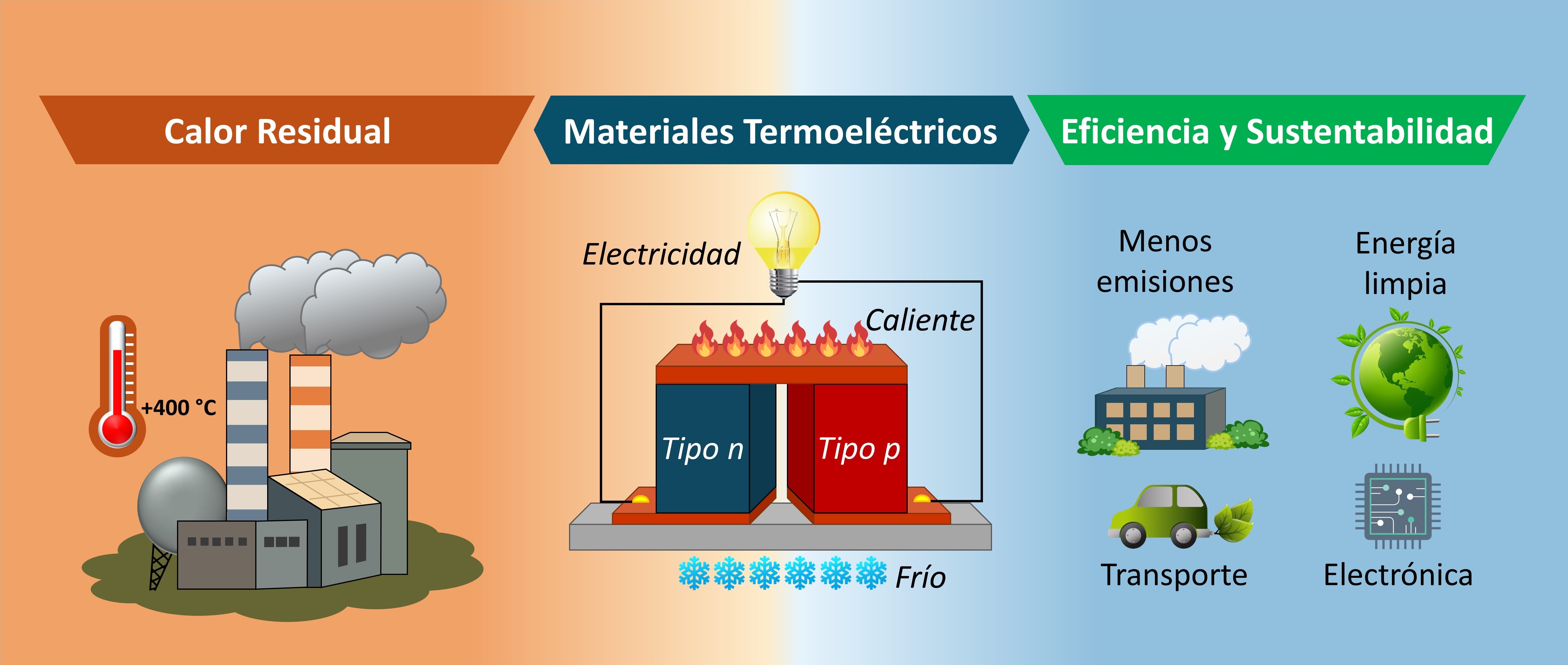
El crecimiento de la demanda energética mundial y los efectos del cambio climático han impulsado la búsqueda de tecnologías capaces de mejorar la eficiencia en el uso de la energía y reducir el impacto ambiental de las actividades industriales. En numerosos procesos productivos, una fracción considerable de la energía consumida se pierde en forma de calor residual, el cual suele disiparse al ambiente sin ser aprovechado. La recuperación de este calor representa una oportunidad importante para optimizar el uso de la energía y disminuir las emisiones de gases de efecto invernadero. Entre las tecnologías emergentes para aprovechar esta fuente energética destacan los generadores termoeléctricos (TEG), dispositivos capaces de convertir directamente gradientes de temperatura en electricidad mediante el efecto Seebeck. En sectores industriales como el cementero, metalúrgico, automotriz, químico y de generación eléctrica, los TEG pueden contribuir al desarrollo de una industria más sustentable al recuperar parte de la energía desperdiciada y reducir el consumo de combustibles fósiles. Estos sistemas emplean materiales semiconductores capaces de transformar el flujo de calor en corriente eléctrica sin requerir partes móviles ni etapas intermedias, lo que disminuye los requerimientos de mantenimiento y mejora la confiabilidad operativa. En los últimos años, los avances en ciencia de materiales, nanotecnología y modelado computacional han permitido mejorar significativamente el desempeño de los materiales termoeléctricos. Sin embargo, aún existen importantes limitaciones relacionadas con la baja eficiencia de conversión energética, el alto costo de materiales como el telurio, la estabilidad térmica a largo plazo y la disponibilidad limitada de algunos elementos críticos utilizados en la fabricación de estos dispositivos. En este contexto, el presente artículo analiza el potencial de los materiales termoeléctricos para la recuperación de calor residual, abordando sus fundamentos físicos, los materiales más relevantes, sus aplicaciones actuales y los principales desafíos tecnológicos para su implementación a gran escala.
Citas
Aminorroaya, S., Santos, R., Fortulan, R., Gazder, A. A., Malhotra, A., Vashaee, D., Serhiienko, I., & Mori, T. (2023). Room-temperature thermoelectric performance of n-type multiphase pseudobinary Bi₂Te₃–Bi₂S₃ compounds: Synergic effects of phonon scattering and energy filtering. ACS Applied Materials & Interfaces, 15(15), 19220–19229. https://doi.org/10.1021/acsami.3c01956 DOI: https://doi.org/10.1021/acsami.3c01956
Barua, N. K., Lee, S., Oliynyk, A. O., & Kleinke, H. (2025). Thermoelectric material performance (zT) predictions with machine learning. ACS Applied Materials & Interfaces, 17(1), 1662–1673. https://doi.org/10.1021/acsami.4c19149 DOI: https://doi.org/10.1021/acsami.4c19149
Besarati, S. M., & Goswami, D. Y. (2017). Supercritical CO₂ and other advanced power cycles for concentrating solar thermal (CST) systems. En Advances in concentrating solar thermal research and technology (pp. 157–178). Elsevier. https://doi.org/10.1016/B978-0-08-100516-3.00008-3 DOI: https://doi.org/10.1016/B978-0-08-100516-3.00008-3
Bhakta, S., & Kundu, B. (2024). A review of thermoelectric generators in automobile waste heat recovery systems for improving energy utilization. Energies, 17(5), 1016. https://doi.org/10.3390/en17051016 DOI: https://doi.org/10.3390/en17051016
Boro, P. R., Deka, R., Sarmah, P., Borthakur, P. P., & Medhi, N. (2026). Nanostructured semiconductors for enhanced waste heat-to-electricity conversion. The 5th International Online Conference on Nanomaterials, 21. https://doi.org/10.3390/materproc2025025021 DOI: https://doi.org/10.3390/materproc2025025021
Bos, J.-W. G., Mohanty, T., Sparks, T. D., Xie, W., Weidenkaff, A., Grasso, S., Zhang, R., Reece, M. J., Wang, T., Son, J. S., Akbar, S., Nandhakumar, I., Tuley, R., Koz, C., He, R., Ying, P., Bahrami, A., Pacheco, V., Nielsch, K., … Funahashi, R. (2026). 2026 roadmap toward sustainable thermoelectrics. Journal of Physics: Energy, 8(1), 011502. https://doi.org/10.1088/2515-7655/ae2d98 DOI: https://doi.org/10.1088/2515-7655/ae2d98
Choi, S., Son, I., & Lee, J. (2023). Comparative performance evaluation of gas Brayton cycle for micro–nuclear reactors. Energies, 16(4), 2065. https://doi.org/10.3390/en16042065 DOI: https://doi.org/10.3390/en16042065
Dai, Z., Wang, C., Zhang, D., Tian, W., Qiu, S., & Su, G. H. (2021). Design and analysis of a free-piston Stirling engine for space nuclear power reactor. Nuclear Engineering and Technology, 53(2), 637–646. https://doi.org/10.1016/j.net.2020.07.011 DOI: https://doi.org/10.1016/j.net.2020.07.011
Eyidogan, M., Canka Kilic, F., Kaya, D., Coban, V., & Cagman, S. (2016). Investigation of organic Rankine cycle (ORC) technologies in Turkey from the technical and economic point of view. Renewable and Sustainable Energy Reviews, 58, 885–895. https://doi.org/10.1016/j.rser.2015.12.158 DOI: https://doi.org/10.1016/j.rser.2015.12.158
Forman, C., Muritala, I. K., Pardemann, R., & Meyer, B. (2016). Estimating the global waste heat potential. Renewable and Sustainable Energy Reviews, 57, 1568–1579. https://doi.org/10.1016/j.rser.2015.12.192 DOI: https://doi.org/10.1016/j.rser.2015.12.192
Gayner, C., Menezes, L. T., Natanzon, Y., Kauffmann, Y., Kleinke, H., & Amouyal, Y. (2023). Development of nanostructured Bi₂Te₃ with high thermoelectric performance by scalable synthesis and microstructure manipulations. ACS Applied Materials & Interfaces, 15(10), 13012–13024. https://doi.org/10.1021/acsami.2c21561 DOI: https://doi.org/10.1021/acsami.2c21561
Goldsmid, H. J. (2016). Introduction to thermoelectricity (Vol. 121). Springer Nature. https://doi.org/10.1007/978-3-662-49256-7 DOI: https://doi.org/10.1007/978-3-662-49256-7
He, J., & Tritt, T. M. (2017). Advances in thermoelectric materials research: Looking back and moving forward. Science, 357(6358). https://doi.org/10.1126/science.aak9997 DOI: https://doi.org/10.1126/science.aak9997
Hung, T. C., Shai, T. Y., & Wang, S. K. (1997). A review of organic Rankine cycles (ORCs) for the recovery of low-grade waste heat. Energy, 22(7), 661–667. https://doi.org/10.1016/S0360-5442(96)00165-X DOI: https://doi.org/10.1016/S0360-5442(96)00165-X
Iavnic, T., Puiu, D., & Popescu, A. (2023). Energy recovery from ice waste heat using thermoelectric generators. Bulletin of the Polytechnic Institute of Iași. Machine Constructions Section, 69(4), 21–35. https://doi.org/10.2478/bipcm-2023-0032 DOI: https://doi.org/10.2478/bipcm-2023-0032
International Energy Agency. (2023). World energy outlook 2023. https://www.iea.org/reports/world-energy-outlook-2023
International Energy Agency. (2024a). Energy efficiency 2024. https://www.iea.org/reports/energy-efficiency-2024
International Energy Agency. (2024b). Energy technology perspectives 2024. https://www.iea.org/reports/energy-technology-perspectives-2024
Ji, D., Haile, N. F., Li, X., Li, B., Rezeq, M., Cantwell, W., & Zheng, L. (2026). Band degeneracy and convergence in high performing thermoelectric materials. Applied Energy, 404, 127182. https://doi.org/10.1016/j.apenergy.2025.127182 DOI: https://doi.org/10.1016/j.apenergy.2025.127182
Jiang, Y., Wang, Y., Yan, J., Shen, L., & Qin, J. (2024). Research on the performance of thermoelectric self-powered systems for wireless sensor based on industrial waste heat. Sensors, 24(18), 5983. https://doi.org/10.3390/s24185983 DOI: https://doi.org/10.3390/s24185983
Jood, P., Ohta, M., Yamamoto, A., & Kanatzidis, M. G. (2018). Excessively doped PbTe with Ge-induced nanostructures enables high-efficiency thermoelectric modules. Joule, 2(7), 1339–1355. https://doi.org/10.1016/j.joule.2018.04.025 DOI: https://doi.org/10.1016/j.joule.2018.04.025
Kyrimis, S., Lallemand, E., Stiewe, C., Ziolkowski, P., Cowley, A., Müller, E., & de Boor, J. (2025). Performance improvement of radioisotope thermoelectric generators (RTGs) by design optimization. Energy Conversion and Management: X, 28, 101395. https://doi.org/10.1016/j.ecmx.2025.101395 DOI: https://doi.org/10.1016/j.ecmx.2025.101395
Liu, Z.-Y., Zhu, J.-L., Tong, X., Niu, S., & Zhao, W.-Y. (2020). A review of CoSb₃-based skutterudite thermoelectric materials. Journal of Advanced Ceramics, 9(6), 647–673. https://doi.org/10.1007/s40145-020-0407-4 DOI: https://doi.org/10.1007/s40145-020-0407-4
Nandihalli, N., Gregory, D. H., & Mori, T. (2022). Energy-saving pathways for thermoelectric nanomaterial synthesis: Hydrothermal/solvothermal, microwave-assisted, solution-based, and powder processing. Advanced Science, 9(25). https://doi.org/10.1002/advs.202106052 DOI: https://doi.org/10.1002/advs.202106052
Ojha, A., Sabat, R. K., & Bathula, S. (2024). Advancement in half-Heusler thermoelectric materials and strategies to enhance the thermoelectric performance. Materials Science in Semiconductor Processing, 171, 107996. https://doi.org/10.1016/j.mssp.2023.107996 DOI: https://doi.org/10.1016/j.mssp.2023.107996
Panchal, J., & Shah, M. (2022). A Kalina cycle for low and medium enthalpy abandoned oil and gas reservoirs incorporated with solar technology for power production. En Utilization of thermal potential of abandoned wells (pp. 297–314). Elsevier. https://doi.org/10.1016/B978-0-323-90616-6.00015-4 DOI: https://doi.org/10.1016/B978-0-323-90616-6.00015-4
Pei, Y., LaLonde, A., Iwanaga, S., & Snyder, G. J. (2011). High thermoelectric figure of merit in heavy hole dominated PbTe. Energy & Environmental Science, 4(6), 2085. https://doi.org/10.1039/c0ee00456a DOI: https://doi.org/10.1039/c0ee00456a
Poudel, B., Hao, Q., Ma, Y., Lan, Y., Minnich, A., Yu, B., Yan, X., Wang, D., Muto, A., Vashaee, D., Chen, X., Liu, J., Dresselhaus, M. S., Chen, G., & Ren, Z. (2008). High-thermoelectric performance of nanostructured bismuth antimony telluride bulk alloys. Science, 320(5876), 634–638. https://doi.org/10.1126/science.1156446 DOI: https://doi.org/10.1126/science.1156446
Quan, R., Liu, D., Li, X., Chang, Y., & Wan, H. (2024). Performance evaluation and energy management of an automobile exhaust thermoelectric generator for ISG mild HEV application. Applied Thermal Engineering, 243, 122556. https://doi.org/10.1016/j.applthermaleng.2024.122556 DOI: https://doi.org/10.1016/j.applthermaleng.2024.122556
Rogl, G., Grytsiv, A., Rogl, P., Peranio, N., Bauer, E., Zehetbauer, M., & Eibl, O. (2014). n-type skutterudites (R,Ba,Yb)yCo₄Sb₁₂ (R = Sr, La, Mm, DD, SrMm, SrDD) approaching ZT ≈ 2.0. Acta Materialia, 63, 30–43. https://doi.org/10.1016/j.actamat.2013.09.039 DOI: https://doi.org/10.1016/j.actamat.2013.09.039
Rowe, D. M. (2018). Thermoelectrics handbook. Taylor & Francis Group. https://doi.org/10.1201/9781420038903 DOI: https://doi.org/10.1201/9781420038903
Schneider, T., Müller, D., & Karl, J. (2020). A review of thermochemical biomass conversion combined with Stirling engines for the small-scale cogeneration of heat and power. Renewable and Sustainable Energy Reviews, 134, 110288. https://doi.org/10.1016/j.rser.2020.110288 DOI: https://doi.org/10.1016/j.rser.2020.110288
See, K. C., Feser, J. P., Chen, C. E., Majumdar, A., Urban, J. J., & Segalman, R. A. (2010). Water-processable polymer−nanocrystal hybrids for thermoelectrics. Nano Letters, 10(11), 4664–4667. https://doi.org/10.1021/nl102880k DOI: https://doi.org/10.1021/nl102880k
Shen, S., Alamri, S., Ahmad, S. F., Thaljaoui, A., Ooi, J. B., Khan, M. S., Ghachem, K., & Kolsi, L. (2025). Modeling of new tri-generation system based on triple organic Rankine cycle, Kalina cycle and absorption chiller with heat recovery parameter. Case Studies in Thermal Engineering, 76, 107401. https://doi.org/10.1016/j.csite.2025.107401 DOI: https://doi.org/10.1016/j.csite.2025.107401
Singh, R., Dogra, S., Dixit, S., Vatin, N. I., Bhardwaj, R., Sundramoorthy, A. K., Perera, H. C. S., Patole, S. P., Mishra, R. K., & Arya, S. (2024). Advancements in thermoelectric materials for efficient waste heat recovery and renewable energy generation. Hybrid Advances, 5, 100176. https://doi.org/10.1016/j.hybadv.2024.100176 DOI: https://doi.org/10.1016/j.hybadv.2024.100176
Snyder, G. J., & Toberer, E. S. (2008). Complex thermoelectric materials. Nature Materials, 7(2), 105–114. https://doi.org/10.1038/nmat2090 DOI: https://doi.org/10.1038/nmat2090
Sootsman, J. R., Chung, D. Y., & Kanatzidis, M. G. (2009). New and old concepts in thermoelectric materials. Angewandte Chemie International Edition, 48(46), 8616–8639. https://doi.org/10.1002/anie.200900598 DOI: https://doi.org/10.1002/anie.200900598
Usman, M., Kazim, A. H., Shabbir, A., Abbasi, M. S., & Sarwar, J. (2022). Efficiency enhancement of thermophotovoltaic cells with different design configurations using existing photon recycling technologies. Frontiers in Energy Research, 10. https://doi.org/10.3389/fenrg.2022.917419 DOI: https://doi.org/10.3389/fenrg.2022.917419
Vaqueiro, P. (2024). Advanced thermoelectric materials and devices. ACS Applied Electronic Materials, 6(5), 2797–2798. https://doi.org/10.1021/acsaelm.4c00811 DOI: https://doi.org/10.1021/acsaelm.4c00811
Wang, D., Ding, J., Ma, Y., Xu, C., Li, Z., Zhang, X., Zhao, Y., Zhao, Y., Di, Y., Liu, L., Dai, X., Zou, Y., Kim, B., Zhang, F., Liu, Z., McCulloch, I., Lee, M., Chang, C., Yang, X., … Zhu, D. (2024). Multi-heterojunctioned plastics with high thermoelectric figure of merit. Nature, 632(8025), 528–535. https://doi.org/10.1038/s41586-024-07724-2 DOI: https://doi.org/10.1038/s41586-024-07724-2
Wang, X., Suwardi, A., Lim, S. L., Wei, F., & Xu, J. (2020). Transparent flexible thin-film p–n junction thermoelectric module. npj Flexible Electronics, 4(1), 19. https://doi.org/10.1038/s41528-020-00082-9 DOI: https://doi.org/10.1038/s41528-020-00082-9
Xiao, D., Sun, P., Wu, J., Zhang, Y., Wu, J., Liu, G., Hu, H., Hu, J., Tan, X., He, S., & Jiang, J. (2023). Thermoelectric generator design and characterization for industrial pipe waste heat recovery. Processes, 11(6), 1714. https://doi.org/10.3390/pr11061714 DOI: https://doi.org/10.3390/pr11061714
Yi, S., & Yu, C. (2015). Modeling of thermoelectric properties of SiGe alloy nanowires and estimation of the best design parameters for high figure-of-merits. Journal of Applied Physics, 117(3). https://doi.org/10.1063/1.4906226 DOI: https://doi.org/10.1063/1.4906226
Zebarjadi, M., Esfarjani, K., Dresselhaus, M. S., Ren, Z. F., & Chen, G. (2012). Perspectives on thermoelectrics: From fundamentals to device applications. Energy & Environmental Science, 5(1), 5147–5162. https://doi.org/10.1039/C1EE02497C DOI: https://doi.org/10.1039/C1EE02497C
Descargas
Archivos adicionales
Publicado
Cómo citar
Número
Sección
Licencia
Derechos de autor 2026 Juan Jesús Reyes-Valdez, Edna Carina De la Cruz-Terrazas, Deyanira Del Angel-López, Eugenio Rodríguez-González

Esta obra está bajo una licencia internacional Creative Commons Atribución 4.0.
Los autores conservan los derechos de autor de sus trabajos y conceden a la revista Tendencias en Energías Renovables y Sustentabilidad (TERYS) el derecho de primera publicación.
Los artículos se publican bajo la licencia Creative Commons Atribución 4.0 Internacional (CC BY 4.0), que permite compartir y adaptar el material para cualquier propósito, incluso comercial, siempre que se otorgue el crédito adecuado a los autores y a la revista.
Los autores pueden depositar la versión publicada del artículo en repositorios institucionales o páginas personales, siempre citando la publicación original en TERYS.
 Derechos de autor © D.R. Asociación Latinoamericana de Desarrollo Sustentable y Energías Renovables A. C.,