
¿Se Pueden Remover los Compuestos Per- y Polifluoroalquilados (PFAS) en los Humedales Construidos?
 Descargas: 205
DOI:
https://doi.org/10.56845/terys.v5i2.687Palabras clave:
PFAS, humedales construidos, plantas, sustrato, microorganismosResumen
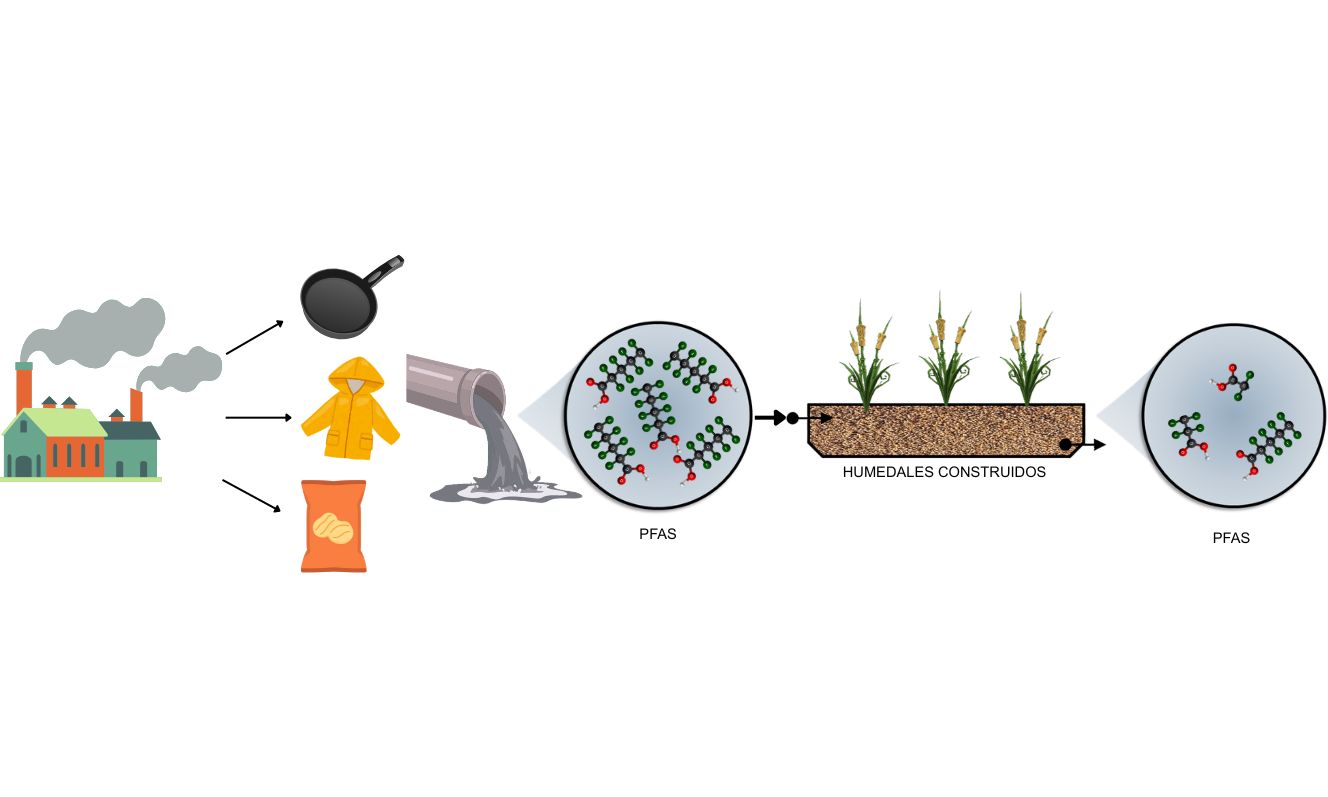
Los compuestos per- y polifluoroalquilados (PFAS) son sustancias sintéticas ampliamente empleadas en sectores como la industria textil, papelera y de empaques, recubrimientos, electrónica y espumas contra incendios; debido a su alta estabilidad química y a su capacidad para repeler agua, aceites y manchas. Por ello, pueden encontrarse en productos cotidianos como textiles impermeables, envases para alimentos y utensilios de cocina antiadherentes. Sin embargo, estas mismas características los convierten en contaminantes altamente persistentes, resistentes a los procesos naturales de degradación y con potencial de generar efectos adversos en la salud humana y los ecosistemas. Este artículo analiza el uso de los humedales construidos (HC) como una alternativa sustentable para el tratamiento de aguas residuales que contienen PFAS, mediante los procesos naturales que ocurren en estos sistemas. En ellos, cada componente desempeña un papel fundamental: las plantas con mayor biomasa y sistemas radiculares complejos favorecen la retención y absorción de contaminantes; los sustratos enriquecidos con materiales innovadores, como el biochar o el carbón activado, incrementan la eficiencia de remoción; y los microorganismos asociados contribuyen a la biotransformación parcial de los PFAS, aunque la ruptura completa de los enlaces carbono-flúor (C-F) continúa representando un desafío.
Citas
Awad, J., Brunetti, G., Juhasz, A., Williams, M., Navarro, D., Drigo, B., Bougoure, J., Vanderzalm, J., & Beecham, S. (2022). Application of native plants in constructed floating wetlands as a passive remediation approach for PFAS-impacted surface water. Journal of Hazardous Materials, 429, 128326. https://doi.org/10.1016/j.jhazmat.2022.128326
Awad, J., Navarro, D., Kirby, J., Walker, C., & Juhasz, A. (2024). Long-term management of PFAS contaminated water using constructed floating wetlands: Opportunities, limitations, and implementation considerations. Critical Reviews in Environmental Science and Technology, 54(24), 1709–1733. https://doi.org/10.1080/10643389.2024.2360762
Bhattacharya, A., Fathima, J., Varghese, S., Chatterjee, P., & Gadhamshetty, V. (2024). Advances in bioremediation strategies for PFAS-contaminated water and soil. Soil & Environmental Health, 100126. https://doi.org/10.1016/j.seh.2024.100126
Dehghani, M. H., Aghaei, M., Bashardoust, P., Ghalhari, M. R., Nayeri, D., Malekpoor, M., Sheikhi, S., & Shi, Z. (2025). An insight into the environmental and human health impacts of per- and polyfluoroalkyl substances (PFAS): Exploring exposure pathways and their implications. Environmental Sciences Europe, 37(1). https://doi.org/10.1186/s12302-025-01122-9
Fenton, S. E., Ducatman, A., Boobis, A., DeWitt, J. C., Lau, C., Ng, C., & Roberts, S. M. (2021). Per- and polyfluoroalkyl substance toxicity and human health review: Current state of knowledge and strategies for informing future research. Environmental Toxicology and Chemistry, 40(3), 606–630. https://doi.org/10.1002/etc.4890
Fuertes, I., Gómez-Lavín, S., Elizalde, M. P., & Urtiaga, A. (2017). Perfluorinated alkyl substances (PFASs) in northern Spain municipal solid waste landfill leachates. Chemosphere, 168, 399–407. https://doi.org/10.1016/j.chemosphere.2016.10.072
Glüge, J., Scheringer, M., Cousins, I. T., DeWitt, J. C., Goldenman, G., Herzke, D., Lohmann, R., Ng, C. A., Trier, X., & Wang, Z. (2020). An overview of the uses of per- and polyfluoroalkyl substances (PFAS). Environmental Science: Processes & Impacts, 22(12), 2345–2373. https://doi.org/10.1039/d0em00291g
Greger, M., & Landberg, T. (2024). Removal of PFAS from water by aquatic plants. Journal of Environmental Management, 351, 119895. https://doi.org/10.1016/j.jenvman.2023.119895
Hu, B., Zhao, F., Zhang, J., et al. (2025). Mitigating ecological risks: Role of arbuscular mycorrhizal symbiosis in translocation and transformation of per- and polyfluoroalkyl substances in constructed wetlands. Environmental Science & Technology, 59(12), XXX–XXX. https://doi.org/10.1021/acs.est.5c06131
Huang, S., & Jaffé, P. R. (2019). Defluorination of perfluorooctanoic acid (PFOA) and perfluorooctane sulfonate (PFOS) by Acidimicrobium sp. strain A6. Environmental Science & Technology, 53(19), 11410–11419. https://doi.org/10.1021/acs.est.9b04047
Ji, B., Zhao, Y., Yang, Y., Li, Q., Man, Y., Dai, Y., Fu, J., Wei, T., Tai, Y., & Zhang, X. (2023). Curbing per- and polyfluoroalkyl substances (PFASs): First investigation in a constructed wetland-microbial fuel cell system. Water Research, 230, 119530. https://doi.org/10.1016/j.watres.2022.119530
Kang, Y., Guo, Z., Ma, H., Wu, H., & Zhang, J. (2023). Enhanced removal of perfluorooctanoic acid (PFOA) and perfluorooctane sulfonate (PFOS) in constructed wetlands: Iron cycling and microbial mechanisms. ACS ES&T Water, 3(2), 287–297. https://doi.org/10.1021/acsestwater.2c00250
Kumar, R., Dada, T. K., Whelan, A., Cannon, P., Sheehan, M., Reeves, L., & Antunes, E. (2023). Microbial and thermal treatment techniques for degradation of PFAS in biosolids: A focus on degradation mechanisms and pathways. Journal of Hazardous Materials, 452, 131212. https://doi.org/10.1016/j.jhazmat.2023.131212
Li, R., Tang, T., Qiao, W., & Huang, J. (2020). Toxic effect of perfluorooctane sulfonate on plants in vertical-flow constructed wetlands. Journal of Environmental Sciences, 92, 176–186. https://doi.org/10.1016/j.jes.2020.02.018
Liljeström, O., Rosenqvist, D., Berggren Kleja, D., Enell, A., et al. (2025). Pilot-scale treatment of PFAS-contaminated groundwater in a subsurface flow constructed wetland: Evaluating multiple plant species. Environmental Pollution, 386, 127199. https://doi.org/10.1016/j.envpol.2025.127199
Liu, S., Zhang, Y., Feng, X., & Pyo, S. (2023). Current problems and countermeasures of constructed wetland for wastewater treatment: A review. Journal of Water Process Engineering, 57, 104569. https://doi.org/10.1016/j.jwpe.2023.104569
Lott, D. J., Robey, N. M., Fonseca, R., Bowden, J. A., & Townsend, T. G. (2023). Behavior of per- and polyfluoroalkyl substances (PFAS) in pilot-scale vertical flow constructed wetlands treating landfill leachate. Waste Management, 161, 187–192. https://doi.org/10.1016/j.wasman.2023.03.001
Ma, H., Kang, Y., Li, M., Dong, J., Wang, Y., Xiao, J., & Guo, Z. (2023). Enhancement of perfluorooctanoic acid and perfluorooctane sulphonic acid removal in constructed wetland using iron mineral: Performance and mechanisms. Journal of Hazardous Materials, 447, 130819. https://doi.org/10.1016/j.jhazmat.2023.130819
Ma, H., Zhang, L., Wang, Y., Kong, G., Yu, X., Guo, Z., Kang, Y., Kuang, S., & Zhang, J. (2024). Strengthening effect of different iron minerals for perfluorooctanoic acid and perfluorooctane sulphonic acid removal in constructed wetlands: Mechanisms of electron transfer and microbial effect. Chemical Engineering Journal, 486, 150199. https://doi.org/10.1016/j.cej.2024.150199
Meegoda, J. N., Bezerra de Souza, B., Casarini, M. M., & Kewalramani, J. A. (2022). A review of PFAS destruction technologies. International Journal of Environmental Research and Public Health, 19(24), 16397. https://doi.org/10.3390/ijerph192416397
Ofiera, L. M., Wintgens, T., & Kazner, C. (2025). Retention of per- and polyfluoroalkyl substances (PFAS) and influencing factors by conventional and modified constructed wetlands treating municipal wastewater effluent. Environmental Technology & Innovation, 39, 104319. https://doi.org/10.1016/j.eti.2025.104319
Pandey, D., Singh, S. V., Savio, N., Bhutto, J. K., Srivastava, R., Yadav, K. K., Sharma, R., Nandipamu, T. M. K., & Sarkar, B. (2024). Biochar application in constructed wetlands for wastewater treatment: A critical review. Journal of Water Process Engineering, 69, 106713. https://doi.org/10.1016/j.jwpe.2024.106713
Qian, X., Huang, J., Yan, C., Xiao, J., Li, X., Wang, L., & Wei, Z. (2023). Comparison of eco-improvement on constructed wetlands with nano zero valent iron introduction under different levels of PFOA stress: Perspectives on plant, microbe, and PFOA removal. Science of the Total Environment, 891, 164052. https://doi.org/10.1016/j.scitotenv.2023.164052
Savvidou, P., Dotro, G., Campo, P., Coulon, F., & Lyu, T. (2024). Constructed wetlands as nature-based solutions in managing per- and poly-fluoroalkyl substances (PFAS): Evidence, mechanisms, and modelling. Science of the Total Environment, 934, 173237. https://doi.org/10.1016/j.scitotenv.2024.173237
U.S. Environmental Protection Agency. (2019). EPA’s per- and polyfluoroalkyl substances (PFAS) action plan (EPA 823-R-18-004).
Wang, F., Wang, M., Xu, L., Qian, J., Zou, B., Huo, S., Guan, G., & Cui, K. (2025). Strategies for the removal of per- and polyfluoroalkyl substances: A review. Catalysts, 15(7), 678. https://doi.org/10.3390/catal15070678
Xiao, J., Huang, J., Wang, Y., & Qian, X. (2023). The fate and behavior of perfluorooctanoic acid (PFOA) in constructed wetlands: Insights into potential removal and transformation pathway. Science of the Total Environment, 861, 160309. https://doi.org/10.1016/j.scitotenv.2022.160309
Zhang, Z., Sarkar, D., Biswas, J. K., & Datta, R. (2022). Biodegradation of per- and polyfluoroalkyl substances (PFAS): A review. Bioresource Technology, 344(Pt B), 126223. https://doi.org/10.1016/j.biortech.2021.126223
Zhao, C., Liu, H., Cheng, D., Wang, Y., Hu, Z., Wu, H., Xie, H., & Zhang, J. (2025). Insights into poly- and perfluoroalkyl substances (PFAS) removal in treatment wetlands: Emphasizing the roles of wetland plants and microorganisms. Water Research, 268, 122702. https://doi.org/10.1016/j.watres.2024.122702
Descargas
Archivos adicionales
Publicado
Cómo citar
Número
Sección
Licencia
Derechos de autor 2026 René Martínez-Gallegos, Grecia A. Ortega-Hernández, Jessica Rocha-Peña, Florentina Zurita-Martínez

Esta obra está bajo una licencia internacional Creative Commons Atribución 4.0.
Los autores conservan los derechos de autor de sus trabajos y conceden a la revista Tendencias en Energías Renovables y Sustentabilidad (TERYS) el derecho de primera publicación.
Los artículos se publican bajo la licencia Creative Commons Atribución 4.0 Internacional (CC BY 4.0), que permite compartir y adaptar el material para cualquier propósito, incluso comercial, siempre que se otorgue el crédito adecuado a los autores y a la revista.
Los autores pueden depositar la versión publicada del artículo en repositorios institucionales o páginas personales, siempre citando la publicación original en TERYS.
 Derechos de autor © D.R. Asociación Latinoamericana de Desarrollo Sustentable y Energías Renovables A. C.,